The EV is a load
The car may be clean and quiet, but the charger can still be a serious electrical load that needs planning.
Hungry EV episode
EV charging turns the utility bill into a manga scene: the car wants power, Madame Peak Rate is waiting, Battery Bull is stretching, and Solar Sensei keeps pointing at the schedule.
The charging lesson
SolarTrading.com treats the EV like a funny hungry character because charging can be one of the biggest new loads in a home or business. The useful idea is simple: charging power, charging time, solar production, battery design, and utility rates belong in the same conversation.
The car may be clean and quiet, but the charger can still be a serious electrical load that needs planning.
Charging during expensive periods can make Madame Peak Rate extremely happy. That is not the goal.
Solar production can support part of the energy picture, especially when the site design and charging behavior line up.
Batteries can add timing and resilience options, but EV charging loads are large and must be designed carefully.
The comedy fight
In the manga, the car plugs in at the worst possible moment and says, “Feed me.” Madame Peak Rate appears instantly with a fork and a utility-bill cape.
The EV charges whenever it wants. The customer does not check the rate schedule, solar production, panel capacity, or other loads. The bill remembers everything.
Charging becomes part of an energy design: when the car needs power, when solar produces, when rates change, and what the electrical system can safely handle.
Manga scenes
Every good comedy needs bad timing. EV charging gives SolarTrading.com the perfect setup: a hungry car, a dramatic utility bill, and a battery mascot trying to keep everyone calm.

The EV plugs in. The garage light flickers. Somewhere in the distance, Madame Peak Rate opens one eye.
“Dinner?” asks the car. “Invoice?” asks Madame Peak Rate.
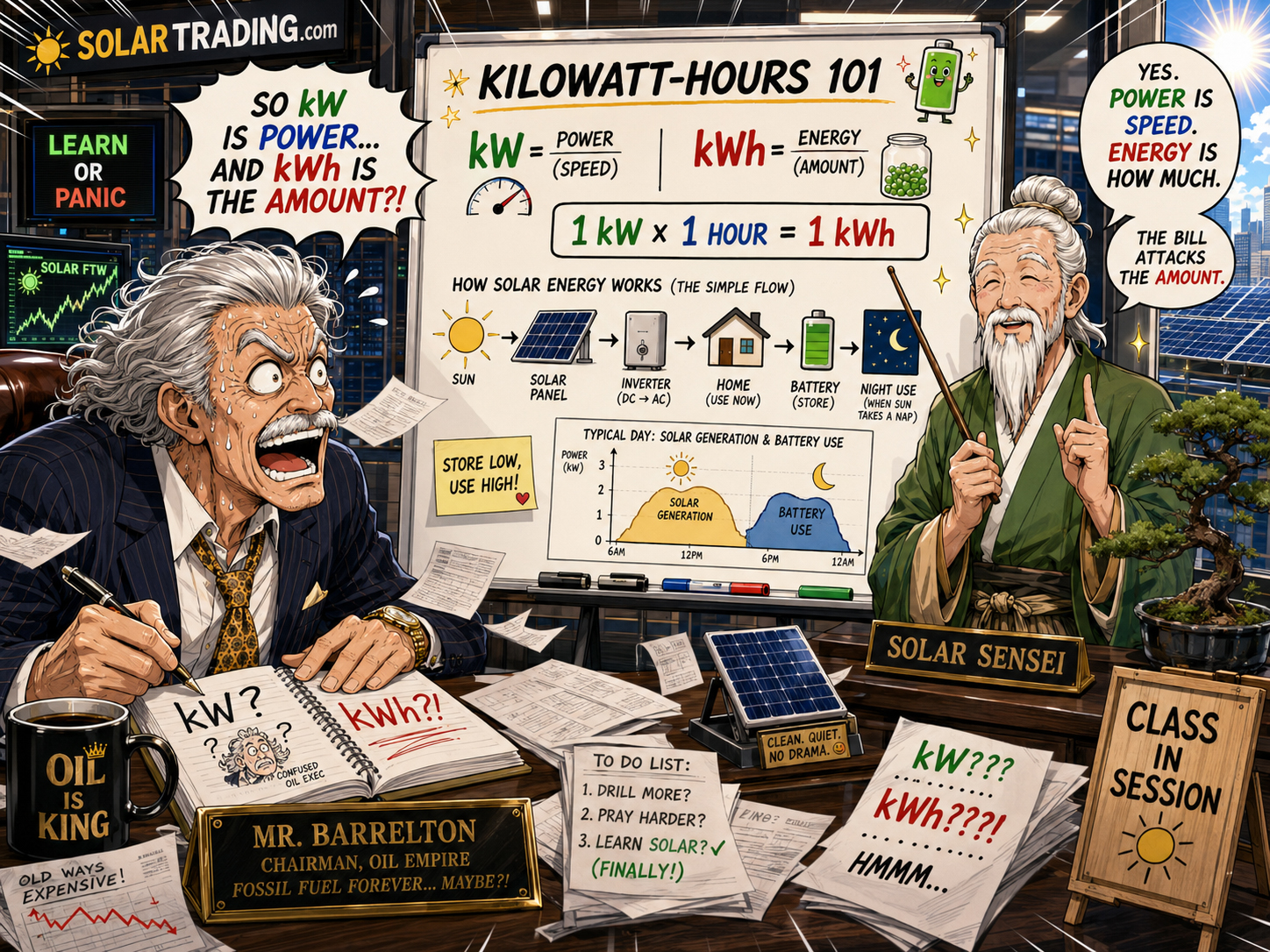
Solar production, EV charging, battery storage, home loads, panel limits, and rate periods all appear on the board.
Mr. Barrelton stares and whispers, “This is not a car. This is a load with wheels.”
Practical lesson
A solar and battery plan should ask how the customer drives, when the vehicle charges, what size charger is used, what the panel can support, and how the utility tariff treats the load.
The system should consider how often and when the EV needs energy.
Solar may help offset EV energy use, but production timing and site limits matter.
EV charging must fit the service, panel, load calculation, equipment, code, and utility requirements.
EV Charging and Solar Trading is the SolarTrading.com way of explaining EV loads without hype: charging is not bad, solar is not magic, batteries are not infinite, and timing can make the whole story smarter.