Episode 8 / finale

The day the sun outtraded oil.

Mr. Barrelton finally learns the hardest lesson for an oil executive: the sun does not need a tanker, a cartel, a refinery, a futures desk, or permission to rise.

Episode 8

The sun wins by showing up.

The finale does not say oil disappears. It says Mr. Barrelton finally understands why solar is a different kind of energy story: it begins on the customer’s property.

Mr. Barrelton remembers the old trading floor
Panel one

The old trading floor looked smaller.

Mr. Barrelton returned to his office. The crude charts still glowed. The phones still rang. Oil Bear still insisted the barrel was the center of civilization.

“Strange,” said Mr. Barrelton. “Why does this room suddenly feel underground?”

The sun outtrades oil in manga style
Panel two

The sun did not shout.

No one called it. No one drilled it. No one refined it. No one hedged it. The sun simply arrived over every roof like it had an appointment with history.

“It has no cartel,” whispered Mr. Barrelton. “That is the joke,” said Solar Sensei.
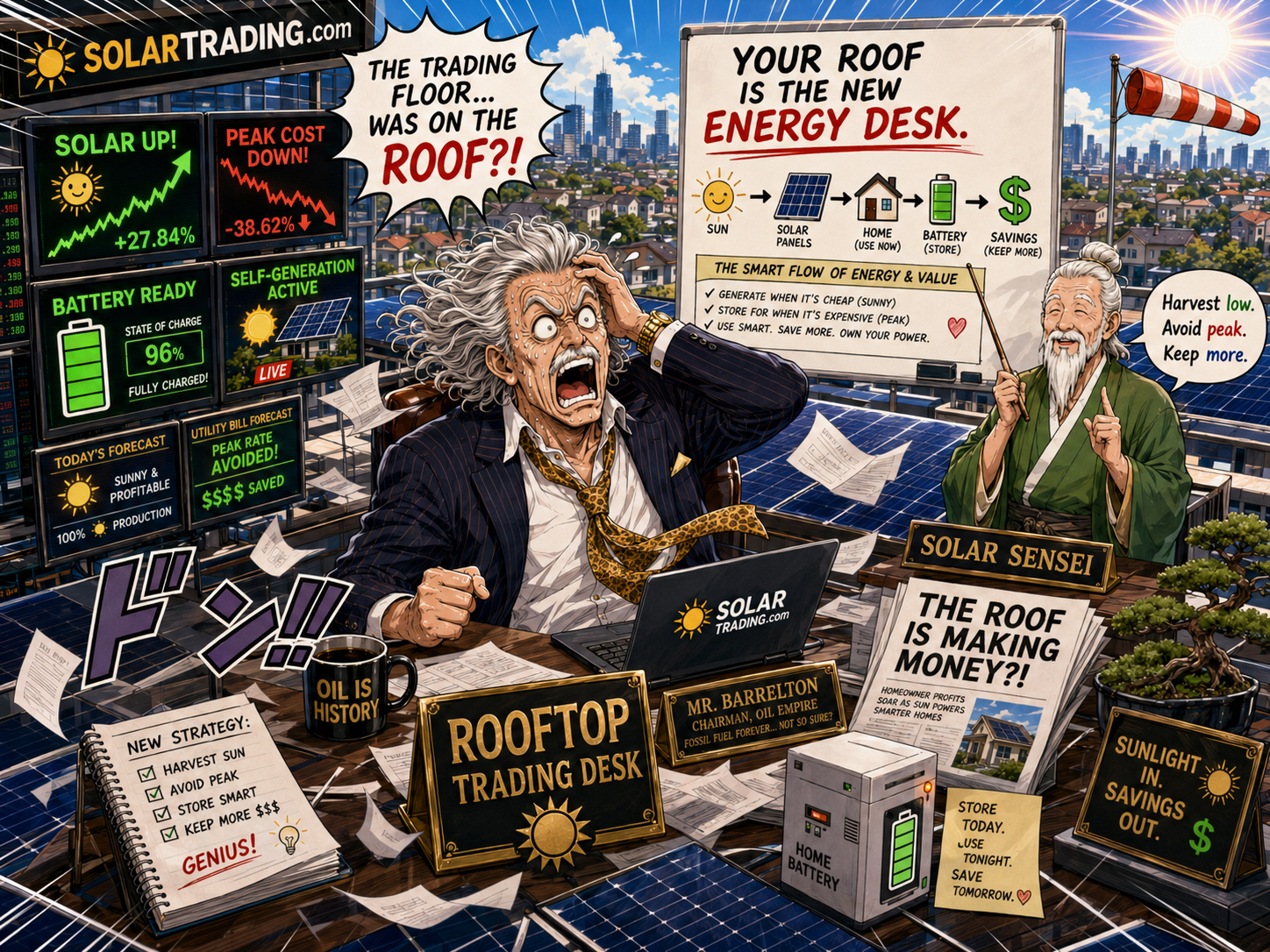
Rooftop becomes the trading desk
Panel three

The roof became strategy.

The roof produced. The meter reported. The loads demanded. The battery waited. The clock mattered. The bill became less mysterious.

“This is not a commodity desk,” said Solar Sensei. “This is customer-owned power.”
Customer-owned power manga poster
Panel four

Mr. Barrelton finally understood.

The customer did not need to own the grid. The customer did not need to become a trader. The customer only needed to stop being asleep.

“The best trade,” said Mr. Barrelton, “is trading ignorance for control.”

The finale lesson

What the sun actually outtraded.

The sun did not beat oil on a trading screen. It “outtraded” the old mental model: centralized supply, passive customers, blind bills, and energy panic.

It outtraded distance

Solar can begin on the customer’s property instead of far away in a fuel supply chain.

It outtraded confusion

Once customers understand kW, kWh, timing, and loads, the bill becomes less mysterious.

It outtraded panic

Batteries, load awareness, and resilience planning can replace blind fear with practical design.

It outtraded passivity

Customer-owned power changes the customer from only a bill receiver into a participant.

“The sun did not win because it shouted louder,” Solar Sensei said. “It won because it kept showing up.”

What Mr. Barrelton learned

The final boardroom notes.

By the end of the first SolarTrading arc, Mr. Barrelton still loves charts. But he no longer thinks the only serious energy story begins with a barrel.

The bill matters

Electric bills are not just numbers. They reveal usage, rates, timing, demand, and behavior.

  • Usage history
  • Rate schedule
  • Peak windows
  • Demand charges

The roof matters

Rooftop solar can turn a property into part of the energy story.

  • Roof condition
  • Sun exposure
  • PV production
  • Permitting

The battery matters

Storage adds timing and resilience options, but must be designed honestly.

  • Capacity
  • Critical loads
  • Runtime expectations
  • Safety design

The finale is not the end. It is the new beginning.

The day the sun outtraded oil is the SolarTrading.com punchline: customer-owned power is not Wall Street, not financial advice, and not magic. It is a new way to understand the roof, the bill, the battery, the clock, and the customer’s role in energy.

Keep reading

Return to the full arc.

The first arc is complete, but the SolarTrading universe has more lessons: EV charging, business demand charges, blackout resilience, and the not-financial-advice page that keeps the jokes honest.

Important: SolarTrading.com is fictional manga satire and educational commentary. It is not financial advice, commodity trading advice, investment advice, tax advice, legal advice, utility-rate advice, engineering advice, emergency advice, EV charging advice, construction advice, or a guarantee of savings, performance, incentives, rate outcomes, interconnection approval, backup duration, or resilience. Solar and battery systems require professional design, load calculations, permitting, interconnection review, inspections, and code-compliant installation.