
Episode 7 / rooftop reveal

The rooftop becomes the trading desk.

Mr. Barrelton finally stops looking for tankers, refineries, and crude charts. Solar Sensei points upward. The desk was above them the entire time.

Episode 7

The old desk had panic. The new desk has timing.

This episode is the thesis of SolarTrading.com. The “trading desk” is not financial advice. It is a comic metaphor for energy awareness: generation, storage, loads, rates, and timing.

Old oil trading floor panic
Panel one

The old desk was loud.

Mr. Barrelton remembered his old trading floor: phones, screens, charts, panic, oil prices, and people yelling at maps as if maps could apologize.

“This was energy,” he said. “This was civilization with neckties.”
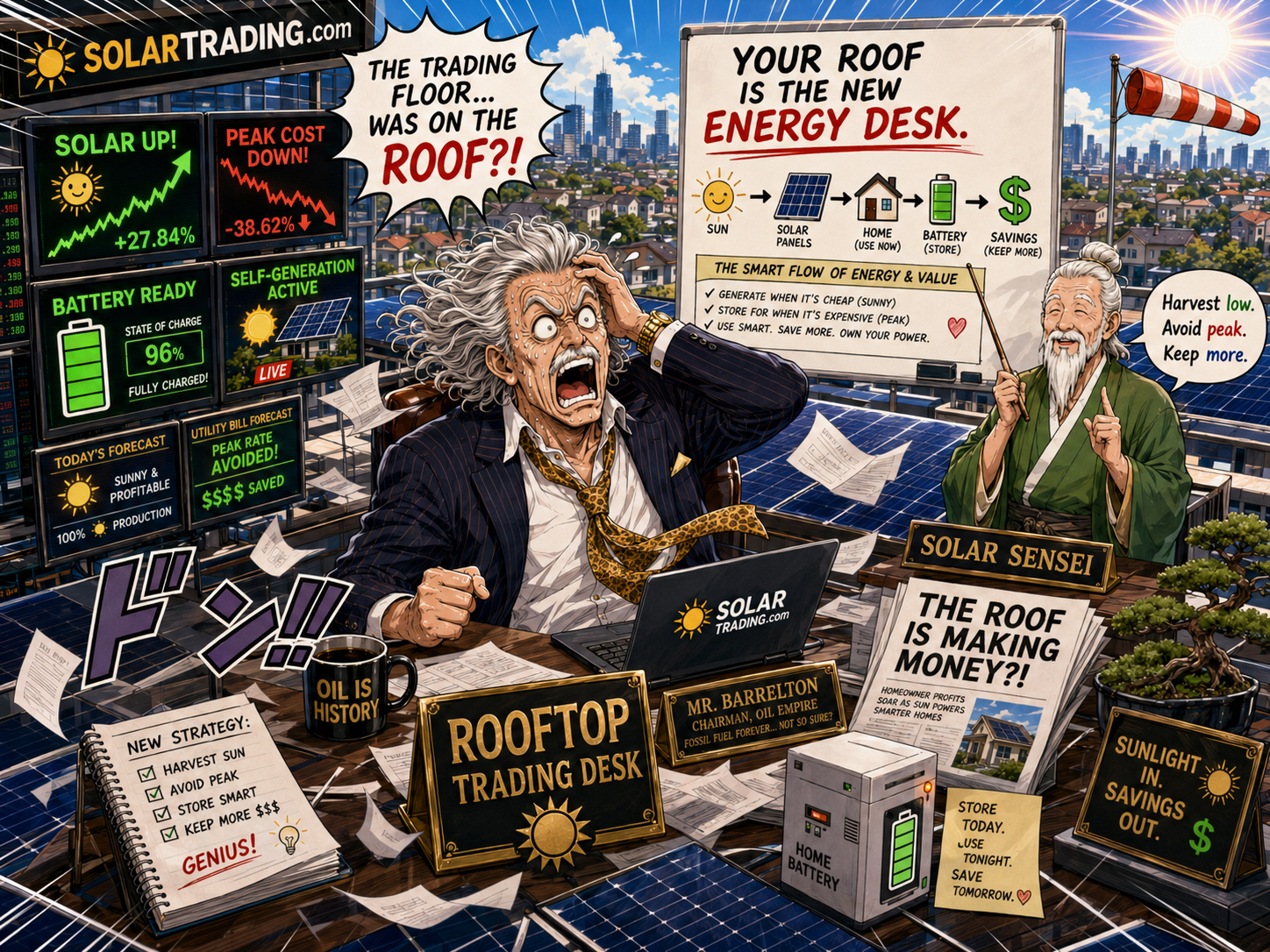
Rooftop becomes the trading desk
Panel two

Solar Sensei opened the roof door.

They walked outside. No phones. No crude charts. No shouting. Just panels, sunlight, the service panel, the meter, and the house below.

“This is the new desk,” said Solar Sensei. “It is quieter because it is actually working.”
Battery Bull and Oil Bear energy showdown
Panel three

Battery Bull joined the meeting.

Battery Bull stood near the loads and watched the clock. Oil Bear asked where the barrel was. Nobody answered. The silence was educational.

“The barrel is not the strategy anymore,” said Battery Bull. “Timing is.”
Electric bill comedy manga
Panel four

The bill became readable.

Suddenly the bill was not just a scary number. It was the report card for usage, timing, solar production, battery behavior, and rate structure.

“The bill is the market report,” whispered Mr. Barrelton. “Careful,” said Solar Sensei. “It is still not financial advice.”

The new desk

Five parts of the rooftop trading desk.

The metaphor works because all five parts interact. Ignore one, and the story becomes cloudy. Understand all five, and the bill starts to make more sense.

The roof

The roof may hold the solar production asset. Its size, direction, shade, and structure matter.

The meter

The meter records the relationship between the property and the grid.

The battery

Storage adds timing and backup possibilities, but only within real capacity and power limits.

The loads

HVAC, EV charging, pool pumps, appliances, motors, and business equipment shape the energy story.

The clock

Rate schedules, solar production windows, and usage behavior make time part of the design.

“The roof is not Wall Street,” said Solar Sensei. “The roof is where the customer stops being asleep.”

What Episode 7 teaches

The customer can own part of the power story.

The rooftop trading desk is a metaphor, not a trading recommendation. The real point is customer-owned power, better energy literacy, and practical design.

Generation

Rooftop solar lets the property produce some power on-site.

  • Roof space
  • Sun exposure
  • Production modeling
  • Utility rules

Timing

Timing affects how solar production, loads, batteries, and rates interact.

  • Peak periods
  • Charging windows
  • Load schedules
  • Battery dispatch

Control

Customer-owned power gives the customer more awareness and more design choices.

  • Critical loads
  • Backup goals
  • Bill literacy
  • System design

Episode 7 reveals the whole machine.

The rooftop becomes the trading desk because the roof, meter, battery, loads, and clock all matter. Mr. Barrelton finally sees that customer-owned power is not oil thinking with panels. It is a different relationship with energy.

Important: SolarTrading.com is fictional manga satire and educational commentary. It is not financial advice, commodity trading advice, investment advice, tax advice, legal advice, utility-rate advice, engineering advice, emergency advice, EV charging advice, construction advice, or a guarantee of savings, performance, incentives, rate outcomes, interconnection approval, backup duration, or resilience. Solar and battery systems require professional design, load calculations, permitting, interconnection review, inspections, and code-compliant installation.